
Work Intelligence · Enterprise Intelligence Suite
Plan for AI at the task level
Decompose every role into tasks. Score AI exposure with the Stanford Human Agency Scale. Forecast where to augment, automate and hold human-in-the-loop — and capture the capacity that comes with it.
Available now on Shiken Enterprise plans.
Account Executive · AI Impact
14 tasks decomposed
31%
Human
48%
Augmentable
21%
Automatable
Top augmentation opportunities
- Discovery call prep+62%
- Proposal drafting+74%
- Follow-up writing+81%
Capacity forecast
~6.4 hours/rep/week reclaimable if AE cohort gains AI-pair skill
Trusted by 30k+ people from top universities & businesses across the world


Inside Shiken
Where the work is already happening
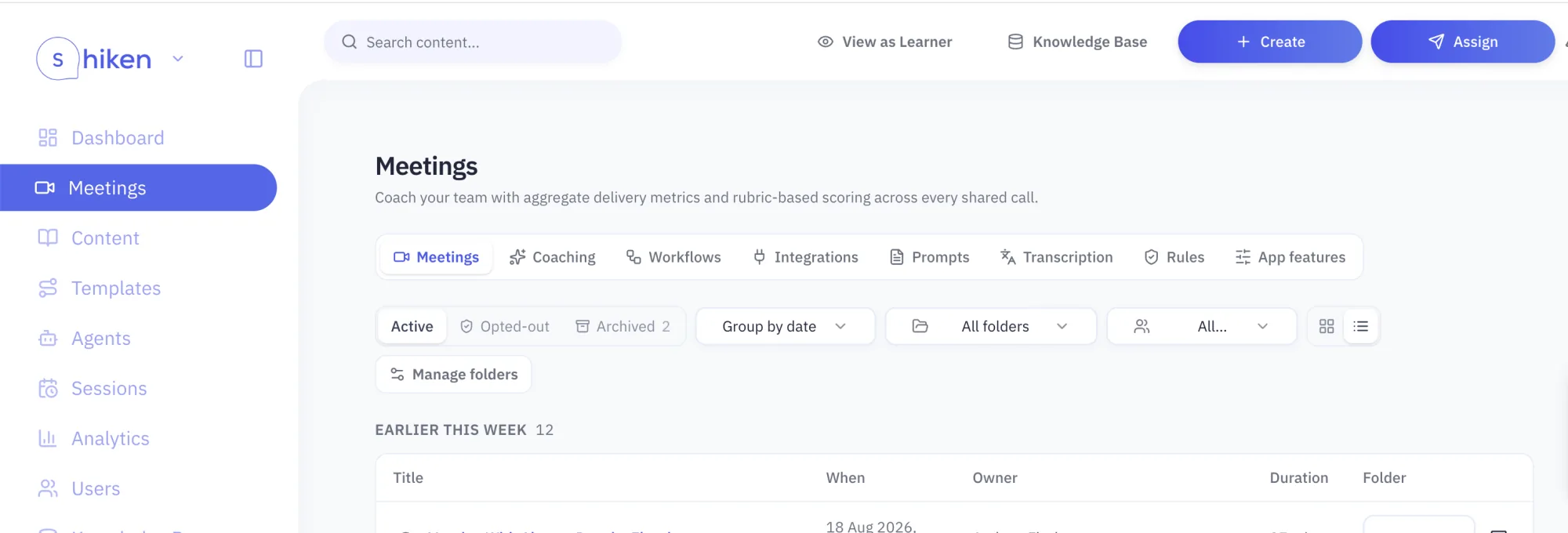
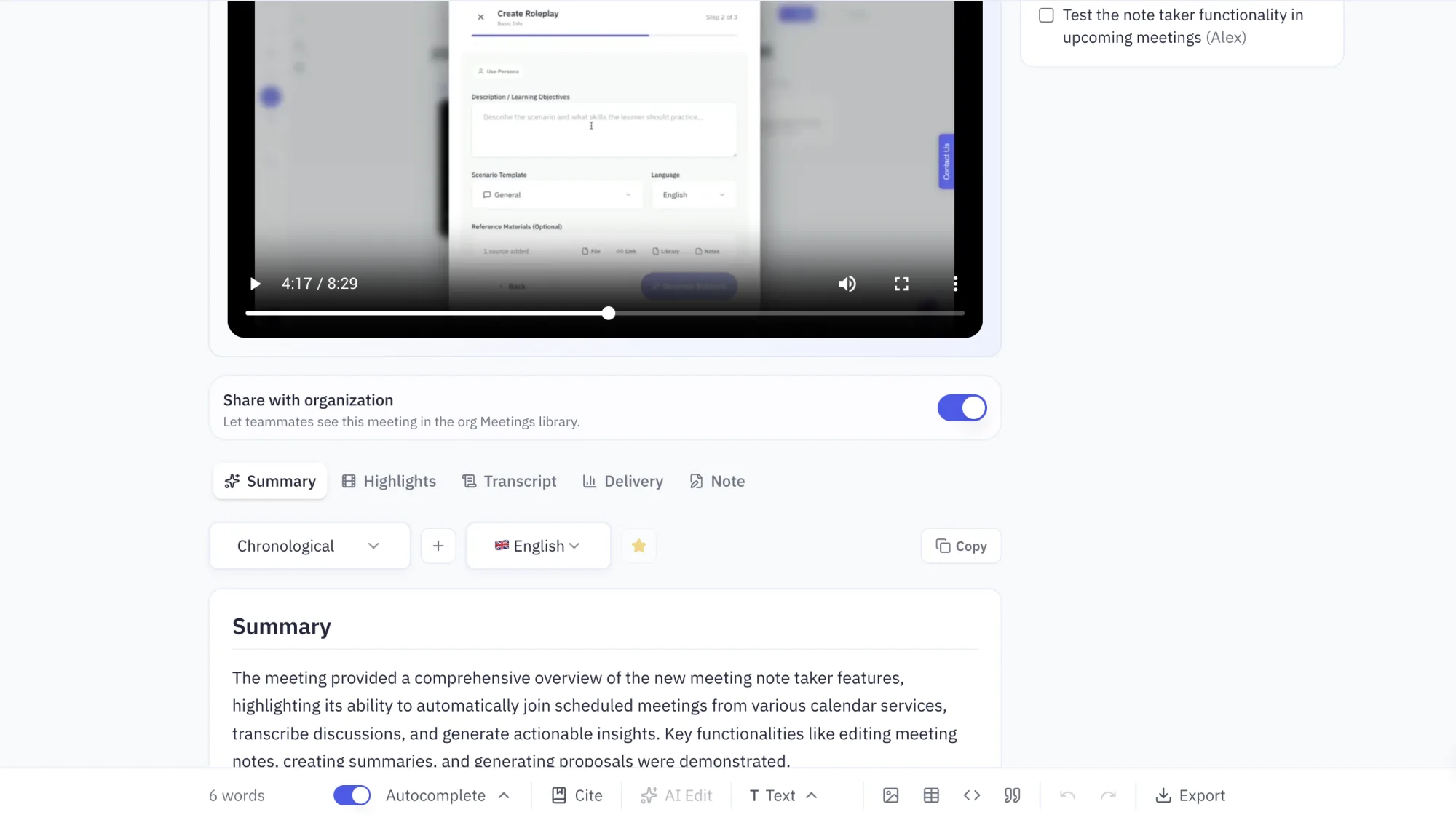
Shiken reads the meetings your team already runs, then turns delivery metrics and rubric scores into coaching — without anyone filling in a form.
How it works
Decompose. Score. Forecast.
Three layers that turn “what does AI mean for our roles?” into a quarter-by-quarter capacity plan.
Decompose work to the task
A role is too coarse for AI planning. Shiken decomposes every role into its component tasks, drawing on org charts, JD libraries, recorded work and ESCO mappings.
- Task-level inventory per role
- Frequency and time-weighted
- Anchored to real recorded work
Score AI impact, not vibes
Every task is scored against the Stanford Human Agency Scale — Human, Augmentable, Automatable — using a structured rubric that maps to the latest research and your tooling.
- Stanford Human Agency Scale rubric
- Tooling-aware scoring (Copilot, GPT-5, etc.)
- Confidence-banded by evidence depth
Forecast capacity by quarter
Project the augmentable and automatable hours per BU, region or function. Plan the capacity gain — and the upskilling that captures it — before the all-hands.
- BU-level capacity forecasts
- Skill gap to capture augmentation
- Linked back to Skills Intelligence
The rubric
Built on the Stanford Human Agency Scale
Three buckets that map to action. Confidence-banded by evidence, refreshed as the tooling landscape evolves.
Human
Stays human-led
Judgement-heavy, relational, or regulated work where human-in-the-loop is mandatory or strongly preferred.
Examples
- ·Compassionate clinical decisions
- ·Compliance attestations
- ·High-stakes 1:1 coaching
Augmentable
Human + AI, together
Work where AI gives material lift but the human still makes the call. This is where most upskilling pays off.
Examples
- ·Sales discovery prep
- ·Marketing brief writing
- ·Code review and design
Automatable
Hand off to AI
Structured, high-volume, low-judgement tasks that can be fully automated — freeing humans for the work that needs them.
Examples
- ·Meeting recap delivery
- ·L1 ticket triage
- ·Standard report generation
Who it's for
For the leaders being asked “what's our AI plan?”
CIO & Chief AI Officer
Move from PoC to portfolio
Stop running disconnected AI pilots. Build a portfolio view of where AI lifts capacity across the org — and which roles need investment to capture it.
- AI portfolio dashboard by BU
- Capacity-gain forecasts in hours and £/$
- Augmentation-ready skill profile gaps
Sample output
Finding
47 disparate AI tools in use, only 3 mapped to capacity plan — concentration unclear
Recommendation
Consolidate to 8 tools, sequence by capacity gain, build governance for the rest
Forecast capacity gain
~2,400 hours/quarter in 12-month plan
CHRO & Workforce Planning
Reshape roles before reshaping headcount
When you can see which 28% of a role is automatable, you can redesign the work, not just the org chart. Capture the gains and avoid the layoff narrative.
- Role redesign playbooks
- Internal mobility into Augmentable roles
- Capacity-aware hiring plans
Sample output
Finding
12% of Customer Support tasks fully automatable, 41% augmentable — re-design before restructuring
Recommendation
Role redesign: Tier-1 specialists with AI co-pilots, route automatable to async AI
Forecast capacity gain
~31% capacity expansion without headcount change
L&D leaders
Target training where AI multiplies it
Train the skills that compound with AI. Shiken connects Augmentable task scores to skill profile gaps to recommend the highest-leverage learning paths per role.
- Augmentation-aligned learning paths
- AI fluency embedded by function
- ROI measured in capacity, not completion
Sample output
Finding
AE cohort missing AI-pair skills for 6 of top 8 Augmentable tasks
Recommendation
Targeted AI-pair-programming microlearning + roleplay rollout, 2-week cadence
Forecast capacity gain
~6.4 hours/rep/week if cohort hits L3 by Q2
Enterprise Intelligence Suite
Three questions every L&D leader needs to answer
One data foundation, three flagship products — needs, skills and work. Each answers a question the others can't.
Needs Analysis
“What training do they need right now?”
Diagnose what to train, fast
A guided 3-stage agent workflow — plan the audience, interview them with multi-channel polls, and roll up the priorities into board-ready needs reports.
- •Audience-first planning with org context
- •Polls, drip and conversational surveys
- •Auto-generated needs reports with citations
Skills Intelligence
“What skills does our workforce have today?”
See the skills you actually have
A continuous skills engine that infers competencies from real work — meetings, roleplays, learning, code, tickets — and reconciles them with self-declared and HRIS data.
- •Inference from work signals, not surveys
- •Validation loop with explainable evidence
- •Role-fit and gap analysis at scale
Work Intelligence
“What work do they do, and where does AI fit?”
Plan for AI at the task level
Decomposes roles into tasks, scores AI exposure with the Stanford Human Agency Scale, and forecasts where to augment, automate or hold human-in-the-loop.
- •Task-level AI impact scoring
- •Augmentable vs automatable forecasts
- •Capacity plans aligned to org goals
You're here
Built with Responsible AI guardrails
Decision-support, not deterministic. Audit trails on every score. Works-council friendly. EU AI Act ready. Customers using Work Intelligence stay in control of how outputs feed into people decisions.
Enterprise-ready security & ethicsEU AI Act
Ready
Stanford HAI
Aligned
Audit logs
Every score
Opt-out
Per employee
Work Intelligence FAQs
How does Shiken score AI impact?
Where does the task data come from?
Is this just about replacing people with AI?
How does this connect to Skills Intelligence?
How accurate is the forecast?
Is this ethical / legal in our jurisdiction?
Plan for AI like an asset, not a vibe
Work Intelligence decomposes every role into tasks and shows you where to augment, automate and hold human-in-the-loop — so you can plan AI capacity with confidence.